It started after Covid sent us all home, and has been ramping up in intensity and frequency since. It’s gotten in the way of my job, it’s dissolved many of my personal relationships, and is likely the reason that I spend almost all of my time by myself. I’ve been calling it paranoia, pareidolia, synchronicities, apophenia, and even thought it might be early onset schizophrenia (I spelled that right on the first try, no spellcheck).
The experience is 100% all the way in qualia, other than perhaps how frequently it occurs. As a result, it’s incredibly difficult to document, explain, relate, or understand what is even happening. This ineffability leads to self-gaslighting, causing one’s trust in oneself to erode over time. I’ve been so lost in this fog-of-unreality that I find myself frequently stating to acquaintances and close friends/family alike “I can’t tell if you’re being sincere or sarcastic.” but find it difficult to believe their answer, regardless of which way it goes.
I’m calling this experience The Anonymous Schema Phenomenon, and I’ll explain why in a bit, but more importantly: I FINALLY HAVE AN EXAMPLE!!!
Well, two examples, I guess. Below are two tiktoks from Brave Dave (no relation, nice name tho). Watch both with maybe 1-2 minutes of a gap between plays so the scope of the first doesn’t leak into the second. When I saw them and arrived at this concept, it was half an hour or so between the two, but I’m going to explain so it’s not the end of the world if you don’t feel it quite as acutely as I did.
Even the caption to the video makes it clear that there are multiple layers to what he’s saying. Unless I miss my guess, which I couldn’t tell if I did, this is subtext. Words blended with nuance and subtlety so well it’s a fully homogenous mixture. It’s neither black or white or red, but a vaguely pinkish-gray. Or maybe it’s just gray, but you can’t quite tell.
At the end, he points out that there is definitely some red mixed in, which is something that most speakers don’t do, in my experience. This was about laundry, but it’s also not at all about laundry. It’s a metaphor ∩ a framing device ∩ subtext.
Now’s a great time to go get a drink of water, or pee, or stretch. Let your mental content palette air out for a few minutes and then continue.
Or don’t, I’m going to explain it anyway. It’s both what I do, and why you’re here…
After re-watching them so close together, I think I picked out at least a few significant differences between the two. The first one starts with laundry as the parent topic, and slowly digresses until at the last second, Dave becomes less Brave and admits he’s projecting. In the video to the right, he mentions Taylor Swift rather briefly, then hard-pivots to a different topic talking about olives. I remembered this as the “Olive One” in my head, but at the end of this I felt like olives were a stand-in for something else, but I couldn’t tell what. Relationships? Groups of people? Genre’s of music?
I’m probably misusing the aphorism, but I think I’m losing the forest in the trees, except it’s more like the pine forest and the olive orchard next door to it, The syntactical thread connecting the two is so thin that I couldn’t see it.
So this has been an educational bit of self-reflection, but I still don’t have any clear indication (on the macro scale) as to what’s happening. This might not be the best example, because in hindsight, it clearly was a metaphor. I just didn’t hold onto the context through the whole monologue. In this instance, mystery solved! YAY!
But this happens to me at least once in almost every social interaction. I’m pretty confident that most of the time (more than half) people aren’t weaving grand tapestries of meaning hidden in layers upon layers. They mean roughly what they say, accounting for biases/filters on both sides of the exchange. The greater issue lies in reality, where I can’t play a video back or write a 1,000 blog post dissecting TikToks and proving that I’m not crazy to myself, if not anyone else.
They say “Trust is like money, easy to destroy, difficult to re-acquire” or something like that. Western society as a group contains a sliver of implicit trust of our fellow human that stems from collectively-enforced individually-scoped security: out-of-control dangerous things are kept away from the citizenry by institutions, namely the government/police. So if one shreds their trust with everyone they know, they still have that sliver to fall back on as a starting point. Self-trust doesn’t work like that.
The same way Emannuel Kant posited “If the will of man is perverse, how can man follow the will of God without corrupting it?”
A classic catch-22. How do I trust my perceptions, opinions, and conclusions as reliable enough to judge them as untrustworthy in the first place? Intuition isn’t a great answer, but it’s a second-order approximation. The same way that native English speakers know “The red big old truck” isn’t correct, but “The big old red truck” is. It’s an unknown-known.
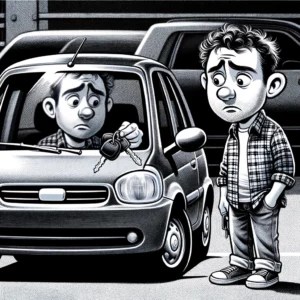
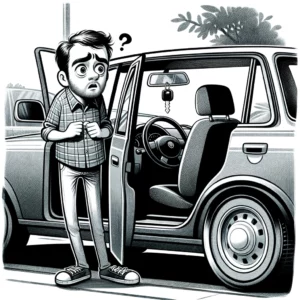
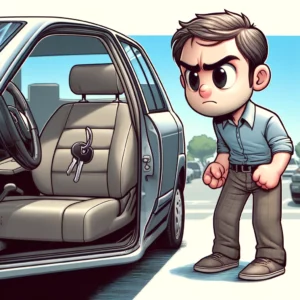
My father was a big fan of the phrase ‘if you tell yourself the same lie often enough, for long enough, you’ll eventually believe it to be true.” I think I did that precisely; “I’m not trustworthy” was the lie, and I believe it enough that I have no way to remove it. The keys are locked in the car.
I tried to get DALLE/GPT-4 to generate a photo for this last paragraph of a man who locked his keys in his car. 0/3 successes on that one. It’s pretty clearly we’ve over-emphasized the intelligence part of AI.