
I hand-waved away a new term I coined with “…I’ll explain why in a bit…”, and proceeded to explain the phenomenon, never circling back to explain the term’s name. Despite being told I enjoy hearing my own voice, and this being written, I’ll do my best to keep things short.
What’s a schema?
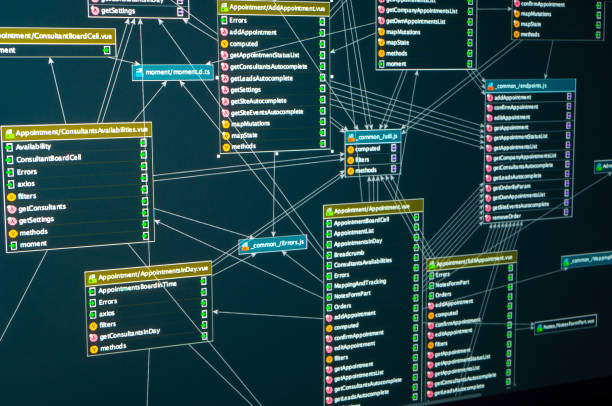
My recent experience as a web developer has exposed me to a different thought paradigm than the broader electronics/computing one I grew up with. I often think of things in terms of input/output streams, workload chunking, organization and storage optimization, etc. I’m sure most people use similar models as well, just frame them differently. That being said, a schema is a programmatic shape of a particular object. Something like this:
In programming, a schema refers to the structure or design of a database. It defines the organization of data and how the data is stored, accessed, and manipulated within the database system. A schema in programming typically includes tables, columns, data types, relationships between tables, constraints such as primary keys and foreign keys, and other rules to ensure data integrity.
On the other hand, in a more general context outside of programming, a schema can refer to a cognitive framework or mental model that helps individuals organize and interpret information about the world around them. In psychology and cognitive science, schemas are used to understand how people perceive new information based on their pre-existing knowledge structures.
Why Anonymous?
In Javascript, there are named functions and anonymous functions.
In JavaScript, an anonymous function is a function that doesn’t have a name. Instead of being declared with a specific identifier, like “function myFunction() {}”, it is created on the fly without a name attached to it. Anonymous functions are often used as arguments to other functions or assigned to variables.
All Together Now!
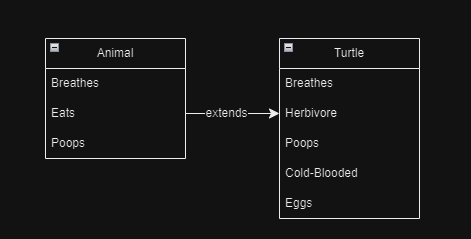
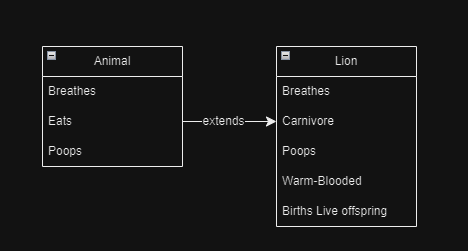
Consider these two “schemas” I’ve diagrammed as a aggressively oversimplification of the concept. Turtles and lions are both part of the animal schema, as everything that fits the parent schema also fits the child schema. At least I hope so, or I need to go learn about turtles. Now if we make the schemas anonymous…
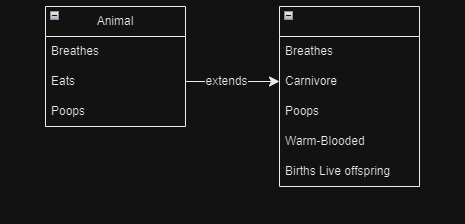
How many different “names” could we give the second schema? Practically infinite, without breaking the extension. That extension is the only thing that’s protecting us from a truly unlimited volume of options.
Is this making sense? I hope it is. I’m learning to leverage it to see my own weaknesses and hypocrisy as I move through the world.
I experienced this today: I had a friend who’s in a rough patch of circumstances, but wouldn’t ask for help or support. They would provide excuses or bad rationalizations to any non-magical solution (meaning “I’ll solve the problem and it won’t cost any money or time to anyone. Magical..) and wouldn’t directly ask for help. I stopped offering to help and acknowledge her struggle without posing solutions, letting her decide if she wants help or just emotional support. She needs to tell me what she wants/needs.
The flip side of that is a separate relationship in my life where I went on a few dates with a woman, and she was still getting over her previous relationship and wasn’t ready for anything long-term yet. I don’t do short-term flings and such, so we decided to keep things platonic. I’m starting to worry that I’m pining over someone, waiting for her to be ready, but that’s not what we discussed. If I’m just waiting and not sincerely being just-a-friend in the present, things likely won’t end the way either of us wants.
I’m going to catch myself here and limit it to “I need to tell her what I want”, before I get away from myself. I had three more paragraphs written on paper that we’ll leave there.
I realized the “I need to xxxxxxx” things after observing about someone else “They need to xxxxxx” the only different of which is the subject [read name]. Anonymous Schema Effect.
I’m smart I promise, you just can’t prove it on paper.